Stewart County Dog Registration Information
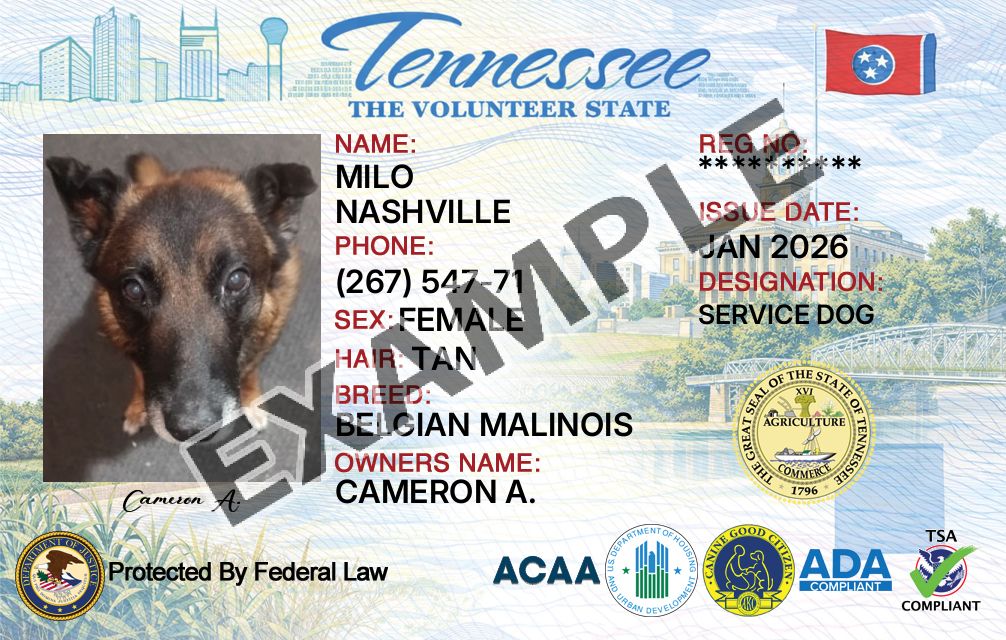
Service Dogs and Emotional Support Animals in Stewart, Tennessee
If you’re searching where do I register my dog in Stewart County, Tennessee for my service dog or emotional support dog, the answer usually involves two separate topics: (1) getting a dog license in Stewart County, Tennessee (often tied to rabies vaccination and handled locally), and (2) understanding what service dog and emotional support animal status means under federal law.
This page explains where to register a dog in Stewart County, Tennessee, what “registration” typically means in practice, and how local public health and animal control rules interact with service dog and ESA rules.
Where to Register or License Your Dog in Stewart County, Tennessee
Because licensing and enforcement are commonly handled at the county level, start with the official offices below. These are typical contact points for animal control dog license Stewart County, Tennessee questions, rabies enforcement, and local tags. If you’re unsure which office issues tags, call first and ask: “Which office issues dog licenses/tags in Stewart County, and what proof do you require?”
Official offices in Stewart County (examples)
| Office | Address | Phone | Hours | |
|---|---|---|---|---|
| Stewart County Clerk |
225 Donelson Parkway Dover, TN 37058 |
(931) 232-7616 | natalie.hardison@tn.gov |
Mon–Fri: 8:00 AM–4:30 PM Closed daily from 12:00 PM–1:00 PM |
| Stewart County Animal Management |
999 Antioch Rd Dover, TN 37058 |
(931) 232-4810 | Not publicly listed | Not publicly listed |
| Stewart County Health Department (Local Health Dept.) |
1021 Spring Street Dover, TN 37058 |
(931) 232-5329 | Not publicly listed | Not publicly listed |
| Stewart County Sheriff’s Office |
314 Cedar Street Dover, TN 37058 |
(931) 232-4053 | Not publicly listed | Not publicly listed |
Quick “who to call first” suggestion
- Start with the Stewart County Clerk if you’re specifically asking about a dog license in Stewart County, Tennessee or a county-issued tag.
- Call Stewart County Animal Management if you’re asking about animal control enforcement, stray/lost dog issues, bite incidents, quarantine guidance, or local ordinances.
- Contact the local Health Department for public-health rabies guidance after a bite/exposure, or for help understanding rabies documentation expectations.
Overview of Dog Licensing in Stewart County, Tennessee
What “licensing” usually means
When people ask where to register a dog in Stewart County, Tennessee, they are usually referring to a local dog license or dog tag issued as part of rabies compliance and local animal control administration. In Tennessee, rabies vaccination rules are statewide, but the details of how licensing is sold, renewed, and enforced are commonly handled locally (county or city).
Rabies vaccination is the foundation
Tennessee law requires dogs and cats (generally over 6 months old) to be currently vaccinated against rabies, with vaccination performed by or under the supervision of a veterinarian, and supported by a rabies vaccination certificate. Keep your rabies certificate in a safe place and bring a copy when you apply for or renew a license/tag.
Service dogs and ESAs still follow public health rules
A service dog can have special access rights under federal disability law, but that does not automatically remove basic public health and safety requirements like rabies vaccination or applicable animal control rules. If an office asks for rabies proof for a tag, that request typically applies to all dogs, including service dogs.
How Dog Licensing Works Locally in Stewart County, Tennessee
Step-by-step: how to get a local license/tag
- Confirm the issuing office. Start by calling the Stewart County Clerk and ask whether they issue dog licenses/tags directly, and if not, which office does.
- Get a current rabies vaccination. Your veterinarian should provide a rabies vaccination certificate and often a rabies tag. (A rabies tag is not always the same thing as a county dog license tag, depending on local practice.)
- Bring required documents. Many offices request proof of rabies vaccination; some may also request identification and proof of residency.
- Pay the local fee and receive your tag/record. Fees and renewal timelines vary locally. Ask whether licensing is annual, multi-year, or tied to rabies vaccination duration.
- Keep your documents accessible. Keep a copy of your rabies certificate and licensing receipt where you can find them quickly—especially if you travel or need to prove compliance after a bite/exposure incident.
What if your dog is a service dog or emotional support animal?
If your dog is a service dog or emotional support animal, you typically follow the same local licensing steps as any other dog. In other words, the dog’s disability-related role is separate from licensing. If you’re looking for a “service dog registry,” be cautious: many online “registries” are not required by law and may not provide any additional legal rights.
What “animal control dog license Stewart County, Tennessee” can mean
People often use the phrase “animal control dog license Stewart County, Tennessee” to describe the local process because animal control frequently enforces rabies compliance, loose-dog ordinances, bite investigations, and related rules. Even if the county clerk issues the tag, animal control may still be the enforcement point for compliance in the community.
Service Dog Laws in Stewart County, Tennessee
What makes a dog a “service dog” (not a license)
Under the Americans with Disabilities Act (ADA), a service animal is generally a dog that is individually trained to do work or perform tasks for a person with a disability. The legal status comes from the dog’s training and function related to a disability—not from buying a certificate, registering online, or obtaining a vest.
Access rights in public places vs. local licensing
Service dogs generally must be allowed in areas open to the public (with limited exceptions). However:
- Local animal control/public health rules still apply. Being a service dog does not mean the dog is exempt from rabies vaccination requirements or other lawful rules applied to all dogs.
- Businesses can still require control. In practice, service dogs must be under control (usually harnessed/leashed/tethered unless that interferes with the dog’s work or the handler’s disability).
- No required “service dog registration.” If someone tells you that you must buy a registration to make your dog a service dog, that’s not how ADA service dog status works.
Best practice in Stewart County: keep two sets of records
For day-to-day life, it helps to separate your paperwork into (1) local licensing/rabies records (relevant for animal control, health, and county offices) and (2) any training/handler documentation you choose to keep for your own records. Local licensing offices typically care about rabies and ownership details—not disability documentation.
Emotional Support Animal Rules in Stewart County, Tennessee
ESAs are different from service dogs
An emotional support animal (ESA) is not the same as a service dog under the ADA. ESAs do not automatically have public-access rights to restaurants, stores, and other public accommodations in the same way a trained service dog does. Instead, ESAs are most commonly addressed under housing rules (reasonable accommodations) when the animal provides emotional support that alleviates one or more effects of a disability.
Housing: reasonable accommodation vs. “registration”
In housing contexts, a landlord or housing provider may be required to consider a reasonable accommodation for an assistance animal (which can include an ESA). The key is the relationship between the disability-related need and the animal—not a purchased registry card. If you’re requesting an ESA accommodation, you may be asked for information supporting the disability-related need (within the limits of fair housing guidance and privacy considerations).
Local licensing still matters for ESAs
Even if your dog is an ESA for housing purposes, you should still maintain rabies vaccination compliance and follow any applicable local licensing rules. If your question is specifically where to register a dog in Stewart County, Tennessee, that typically points back to the local licensing/tag process, not an ESA registry.
Frequently Asked Questions
Register A Dog In Other Tennessee Counties
Select your county below to get started with your dog’s ID card. Requirements and license designs may vary by county, so choose your location to see the correct options and complete your pup’s registration.
- Anderson County Dog Registration
- Bedford County Dog Registration
- Benton County Dog Registration
- Bledsoe County Dog Registration
- Blount County Dog Registration
- Bradley County Dog Registration
- Campbell County Dog Registration
- Cannon County Dog Registration
- Carroll County Dog Registration
- Carter County Dog Registration
- Cheatham County Dog Registration
- Chester County Dog Registration
- City of Hartsville County Dog Registration
- City of Lynchburg County Dog Registration
- City of Nashville County Dog Registration
- Claiborne County Dog Registration
- Clay County Dog Registration
- Cocke County Dog Registration
- Coffee County Dog Registration
- Crockett County Dog Registration
- Cumberland County Dog Registration
- Davidson County Dog Registration
- Decatur County Dog Registration
- DeKalb County Dog Registration
- Dickson County Dog Registration
- Dyer County Dog Registration
- Fayette County Dog Registration
- Fentress County Dog Registration
- Franklin County Dog Registration
- Gibson County Dog Registration
- Giles County Dog Registration
- Grainger County Dog Registration
- Greene County Dog Registration
- Grundy County Dog Registration
- Hamblen County Dog Registration
- Hamilton County Dog Registration
- Hancock County Dog Registration
- Hardeman County Dog Registration
- Hardin County Dog Registration
- Hawkins County Dog Registration
- Haywood County Dog Registration
- Henderson County Dog Registration
- Henry County Dog Registration
- Hickman County Dog Registration
- Houston County Dog Registration
- Humphreys County Dog Registration
- Jackson County Dog Registration
- Jefferson County Dog Registration
- Johnson County Dog Registration
- Knox County Dog Registration
- Lake County Dog Registration
- Lauderdale County Dog Registration
- Lawrence County Dog Registration
- Lewis County Dog Registration
- Lincoln County Dog Registration
- Loudon County Dog Registration
- Macon County Dog Registration
- Madison County Dog Registration
- Marion County Dog Registration
- Marshall County Dog Registration
- Maury County Dog Registration
- McMinn County Dog Registration
- McNairy County Dog Registration
- Meigs County Dog Registration
- Monroe County Dog Registration
- Montgomery County Dog Registration
- Moore County Dog Registration
- Morgan County Dog Registration
- Obion County Dog Registration
- Overton County Dog Registration
- Perry County Dog Registration
- Pickett County Dog Registration
- Polk County Dog Registration
- Putnam County Dog Registration
- Rhea County Dog Registration
- Roane County Dog Registration
- Robertson County Dog Registration
- Rutherford County Dog Registration
- Scott County Dog Registration
- Sequatchie County Dog Registration
- Sevier County Dog Registration
- Shelby County Dog Registration
- Smith County Dog Registration
- Sullivan County Dog Registration
- Sumner County Dog Registration
- Tipton County Dog Registration
- Trousdale County Dog Registration
- Unicoi County Dog Registration
- Union County Dog Registration
- Van Buren County Dog Registration
- Warren County Dog Registration
- Washington County Dog Registration
- Wayne County Dog Registration
- Weakley County Dog Registration
- White County Dog Registration
- Williamson County Dog Registration
- Wilson County Dog Registration